ComparisonUpdated for Patch 26.19Updated October 10, 2026 · 10 min read
Porofessor vs Blitz - Which League App Should You Actually Install?
One is the best scouting tool in League. The other is the most complete companion app. They overlap less than you would think, and they share one blind spot neither of them talks about.
Full disclosure: we build Hexgate, a third overlay that does one thing neither of these two does. We have kept the head-to-head honest anyway, because most of the people searching "Porofessor vs Blitz" are choosing between those two, not us, and the answer to that question does not depend on our product.
Short Answer: Porofessor vs Blitz
Porofessor is a scouting tool that happens to include some in-game helpers. Blitz is an everything-app that happens to include scouting. If lobby information changes how you play, Porofessor does that job better. If you want the fewest installs and the most features, Blitz wins.
Pick
Porofessor
If you want to know who is in your lobby
Best-in-class lobby scouting: ranks, win rates, main champions and playstyle tags for all ten players in champ select, plus jungle and ward timers in game.
Overwolf app or standalone Electron app
Free with ads / premium subscription
VSPick
Blitz
If you want one app for everything
Auto rune and build import, loading-screen scouting, jungle timers and ult tracking, teammate spell timers, post-game stats and multi-game support, all without Overwolf.
Electron app (no Overwolf)
Free with ads / Premium, region-based pricing
Third option: Hexgate. If you care about item builds, both leave the same gap: they import the average build. Hexgate adapts the situational items to the enemy team you are facing, with no Overwolf and no ads.
To know who you are playing against: best-in-class lobby scouting with ranks, win rates and playstyle tagsPorofessor
One app for runes, builds, timers and post-game, with no Overwolf requiredBlitz
Multi-game coverage (TFT, Valorant): Porofessor is League-focusedBlitz
The lightest possible footprint: Porofessor runs on Overwolf or as a standalone Electron app, Blitz is Electron; all cost a browser engine of RAMNeither
Builds that adapt to the enemy team: both import static aggregate buildsHexgate
The Core Difference: A Scouting Tool vs an Everything-App
It helps to understand what each app was built to be, because that explains every strength and weakness below.
Porofessor is a scouting tool first. Its job happens in champ select and on the loading screen: it looks up all ten players and surfaces their rank, win rate, games played this season, main role, main champions and behavioral tags built from match history. It is backed by the team behind League of Graphs, so the stats have a long track record. The in-game side (jungle timers, ward timers, objective reminders) is a bonus layered on top of that core.
Blitz is a companion platform. It wants to be the single app you open for League, TFT, Valorant and several other games. For League it covers automatic rune and build import, a loading-screen scouting overlay, in-game jungle timers and ultimate tracking, teammate summoner spell timers, post-game analysis and performance tracking across your match history. No single one of those is the deepest of its kind; the point is that they are all in one place.
So the honest framing is not "which is better" but "which weakness in your play are you trying to fix". If you regularly get surprised by a smurf jungler or an autofilled enemy top, that is Porofessor's category. If you keep forgetting to set runes, want timers without alt-tabbing and like reviewing stats after a game, that is Blitz's category.
Porofessor The Scouting Veteran
Free (ads) / premium subscriptionOverwolf or standalone Electron app
What Porofessor does well
Porofessor's live game lookup is the best-known implementation of its kind. Within seconds of entering champ select you get a full breakdown of every player in the lobby, and the behavioral tags are what make it more than a rank display. Tags like a player being on a loss streak, playing an off-role or one-tricking a champion give you a fast read on where the pressure in the game will come from.
That information has real strategic value. Knowing the enemy top laner is autofilled changes how hard your jungler should path top. Knowing the enemy ADC is on a ten-game win streak tells you which side of the map to play through. Porofessor packages this into an overlay that appears without alt-tabbing, which is exactly where this kind of tool should live.
It also includes in-game helpers: jungle timers, ward timers and objective reminders. They are not the reason to install Porofessor, but if scouting is already the reason, you get them for free.
Where Porofessor falls short
The platform used to be the biggest structural issue. Until December 2025 Porofessor ran only on Overwolf, with Overwolf running as a host and Porofessor as an app inside it, and its Overwolf version still works that way. That is two processes on top of League itself, and on machines with 16 GB of RAM or less the overhead is noticeable. Overwolf overhead is the single most common reason players go looking for Porofessor alternatives. Since December 5, 2025 Porofessor also ships a standalone Electron app, so the Overwolf host is now optional, though the standalone app carries a browser engine of its own.
The free experience is ad-supported, and recent reviews describe the app as feeling increasingly dated, with more frequent error reports than in its prime. The premium subscription removes ads and adds cosmetic and convenience features, but the core scouting data is the same either way.
Porofessor is not a build tool. It can surface popular builds and runes the way most stats sites do, but the recommendations are static, aggregate and pre-game. Nothing in Porofessor looks at the enemy team and tells you to build magic resist this game because three of the five enemies are AP.
Free (ads) / Premium, region-based pricingElectron app (no Overwolf)
What Blitz does well
Blitz is the most feature-complete companion app on the market. Automatic rune and build imports, in-game overlays with jungle timers and ultimate tracking, teammate summoner spell timers, post-game analysis and performance tracking across your history. The breadth is genuinely impressive: if you want a single install that handles champ select through post-game, across multiple titles, Blitz is hard to beat.
Two things stand out against Porofessor specifically. First, Blitz's overlay works without Overwolf. It is a standalone app, which removes the host-platform tax that Porofessor's Overwolf users pay. Second, Blitz has its own loading-screen scouting overlay showing each player's rank, win rate, recent performance and most-played champions. It is not as deep as Porofessor's tag system, but for many players it is enough, which weakens the case for running both.
The post-game side also gives Blitz something Porofessor does not have: a reason to open the app after the match ends.
Where Blitz falls short
Performance overhead is the main criticism. Blitz is an Electron app, so it ships its own browser engine and a real memory baseline next to League; on lower-spec machines that is worth checking in Task Manager.
Advertising is the other. The free tier includes ads, and users have reported autoplay video ads, pop-ups and generally intrusive advertising that makes the free experience feel cluttered. Blitz Premium removes them, with pricing that varies by region.
On the build side, Blitz imports a single static build path: the statistically best build for your champion in your role, decided before the game starts. You get the same recommended items whether you are playing into a full AD team or a heavy AP composition. If you already counter-build manually you can ignore the import; if you follow it, the gap is real.
Hexgate is included as the third column because it is the tool we would pair with either of the other two, not a replacement for them. It answers the in-game item question for free, and Pro+ adds Lane Scouting before the game and a Match Breakdown after it.
Feature
Porofessor
Blitz
Third optionHexgate
Live game scouting
Yes - best in class
Yes - loading screen
Lane opponent and enemy jungler habits (Pro+)
Player tags & history
Yes
Partial
No
Rune import
Yes
Yes - automatic
Yes - one click
Build recommendations
Static, pre-game
Static import
Adaptive, per enemy comp
Jungle/ward timers
Yes
Yes
No
Teammate spell/ult tracking
No
Yes
No
Post-game analytics
No
Yes
Yes - Match Breakdown (Pro+)
Lane matchup scoring
No
No
Yes (Pro)
OTP builds
No
No
Yes (Pro)
Requires Overwolf
No - standalone or Overwolf version
No
No
Framework
Overwolf app or Electron (standalone)
Electron
Native (Tauri/Rust)
Ads on free tier
Yes
Yes
No
Multi-game support
LoL focused
LoL, TFT, Val, more
LoL only
Free tier
Full scouting + ads
Full features + ads
3 games/day, no ads
Paid tier
Premium subscription
Region-based pricing
€9.99/mo or €7.49/mo annual; Pro+ €14.99/mo
Platforms
Windows (standalone or Overwolf)
Windows, macOS (overlay Windows only)
Windows
The Performance and Overwolf Question
This is where the two apps differ most in practice, and it is not a clean win for either.
Porofessor itself is not a heavy app, but its Overwolf version brings a real cost. The host platform plus the app together add a browser-engine-sized footprint alongside League, Discord and whatever else you run. Players on older machines have been complaining about Overwolf overhead for years, and it is the reason "Porofessor without Overwolf" is a search people actually make. Since December 2025 the standalone Porofessor app answers it, as an Electron app with a browser engine of its own.
Blitz avoids Overwolf, which sounds like the win, until you remember it is an Electron app with a browser engine of its own. Not needing a host platform is genuinely better architecture than needing one, but Blitz's baseline footprint means you do not actually get a light app out of the trade. You get a different heavy one.
Rule of thumb: with 16 GB of RAM or more and comfortable FPS, run whichever one you like; the overhead will not decide games. Below that, pick one heavy app at most. If you want a second tool, make it something native and small that does a job the first one does not.
For contrast, Hexgate is a native Tauri/Rust application with no Overwolf and no Electron, typically under 100 MB of memory. An app that only does itemization does not need a browser engine, which means Hexgate is the one tool on this page you can add next to Porofessor or Blitz without the stack getting noticeably heavier.
Safety and Riot Compliance
A question that comes up constantly: will either app get me banned? No.
Public data and Riot's official APIs
No memory reading
No game file changes
No injection
Riot allows third-party tools that surface information a player could theoretically track manually (ranks, win rates, builds, timers) and prohibits tools that provide a measurable unfair advantage, such as exposing hidden information, automating inputs or altering the game's visual field.
Porofessor and Blitz both read publicly available match history and live game data through Riot's official channels. Rune import in both apps goes through the League client's own LCU API, the same mechanism Hexgate uses. Hexgate additionally reads the Live Client Data API that Riot provides locally during active games (https://127.0.0.1:2999/liveclientdata/), which exists precisely for tools like this. None of the three modifies game files, reads game memory or injects into the game process.
The Gap Both Share: Neither Adapts Your Build
Here is the part most Porofessor vs Blitz comparisons skip, and it is the reason we bother writing one.
Both apps hand you an aggregate build. Blitz imports the highest win rate item path for your champion this patch. Porofessor can surface the popular build the same way stats sites do. In both cases the build is computed across all games, with no knowledge of the five enemies you are about to face, and it is decided before minions spawn. Against a balanced comp, that is fine. Against a full AD team, a triple-tank front line or a Soraka plus Aatrox healing stack, the aggregate build is measurably wrong and neither app will tell you.
Counter-building is one of the highest-impact skills in League, and it is the decision that changes most from game to game. Scouting tells you the enemy mid is fed; it does not tell you what to buy about it. Timers tell you when dragon spawns; they do not tell you that armor should be your third item this game.
This is what Hexgate does, and it is the thing it is built around. When the game starts, it reads the enemy team from Riot's Live Client Data API and scores every viable item for your champion and build slot against that specific lobby. Core early items stay pick-rate driven, because the meta start is usually right. The situational slots are where it adapts: the enemy's physical vs magic damage split, crowd control, healing, shields, tankiness and which enemies are fed all move items up or down. Against four AD threats, armor climbs. Against a 7/0 Katarina, anti-burst climbs.
What Hexgate adds
Re-scores every viable item for your champion and build slot against the five enemies you are facing, live in game.
Labels every nudge with its reason in the overlay, so you learn the pattern instead of just following a list.
Native Tauri/Rust app, typically under 100 MB of memory, no Overwolf, no Electron, no ads.
With Pro: lane matchup scoring and OTP builds (what one-trick players actually build on your champion).
With Pro+: a Match Breakdown of every ranked, Draft and Swiftplay game, Lane Scouting of your lane opponent and the enemy jungler on the loading screen, and Clips of every death to rewatch.
What it does not replace
Full lobby scouting: no ranks or playstyle tags for all ten players.
Jungle, ward and spell timers.
Windows only, and the free tier is 3 games per day.
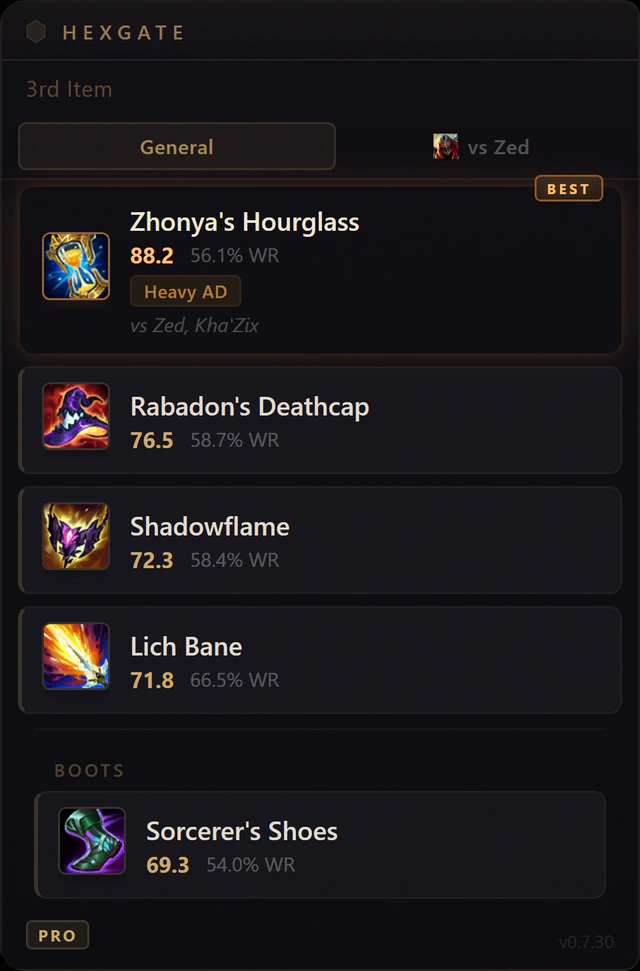
Zed and Kha'Zix on the enemy team: Zhonya's Hourglass jumps to first for Ahri's 3rd item, tagged Heavy AD.
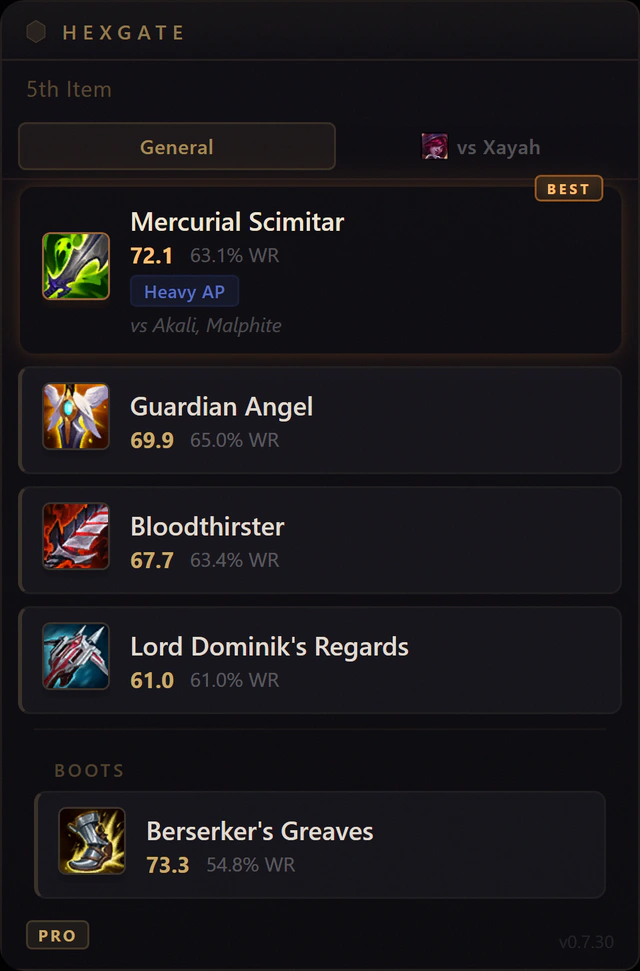
Akali and Malphite on the enemy team: Mercurial Scimitar leads Jinx's 5th item, tagged Heavy AP.
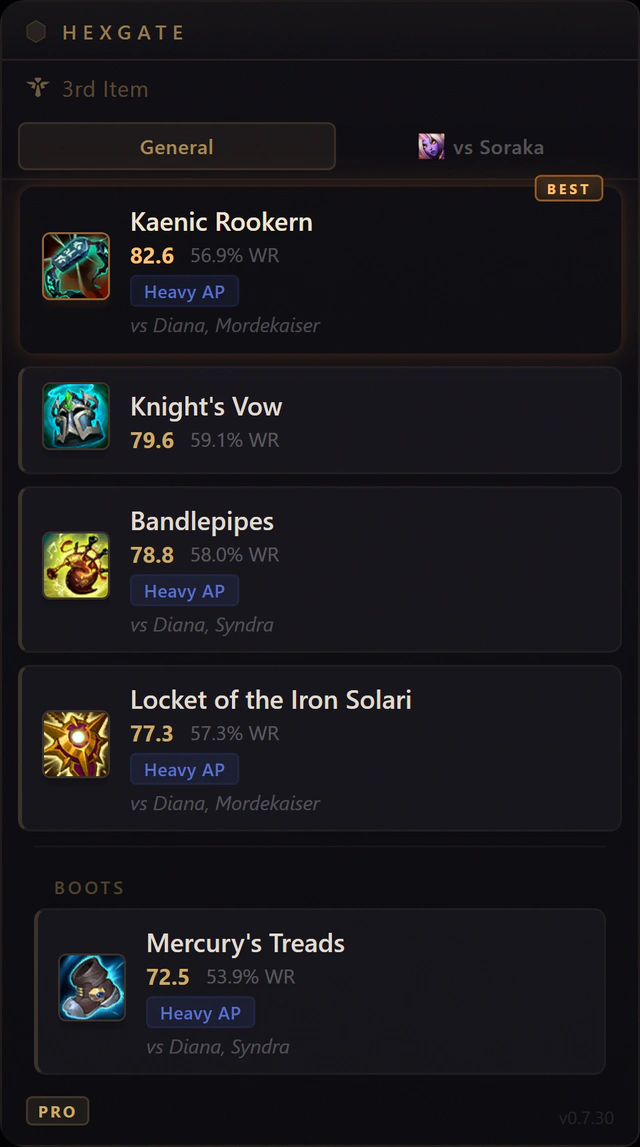
Diana, Mordekaiser and Syndra on the enemy team: Kaenic Rookern leads Leona's 3rd item and the boots switch to Mercury's Treads.
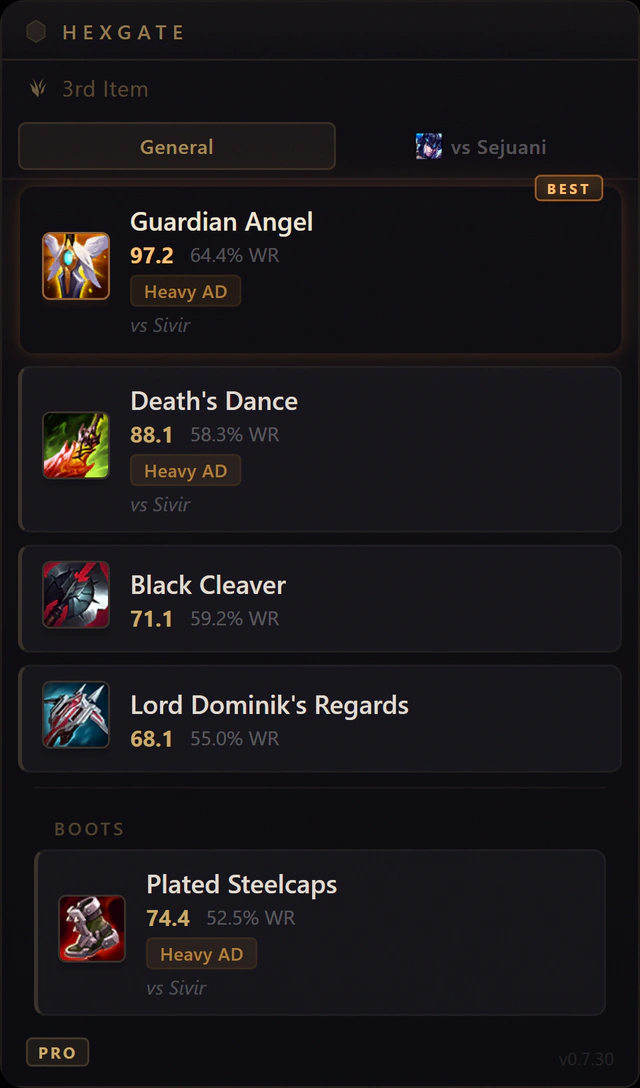
Sivir on the enemy team: Guardian Angel and Death's Dance move to the top of Vi's 3rd item and the boots switch to Plated Steelcaps.
Real screenshots of the Hexgate overlay in game. Pick a champion.
If your builds already adapt, you do not need it
If you have ever finished a game holding the same third item you always buy while a fed assassin one-shots you, that is the leak it closes. Porofessor plus Hexgate covers before-game and during-game with almost no overlap.
Try Hexgate free3 free games per day · No ads · No Overwolf · Under 100 MB
Which One Should You Pick?
Pick Porofessor if scouting decides your games.
If you actively use lobby information (dodging bad matchups, pathing toward weak lanes, respecting smurfs), Porofessor gives you the best version of that information with minimal setup. Accept the ads as the price, plus Overwolf unless you install the standalone version. Its jungle and ward timers cover the basic in-game helpers too.
Pick Blitz if you want everything in one app.
Auto rune import, build import, timers, teammate tracking, post-game stats, loading-screen scouting and multi-game support, all without Overwolf. Blitz's scouting is shallower than Porofessor's, but if you only glance at ranks anyway, the breadth wins. Be ready for the Electron footprint and the ads on the free tier.
Add Hexgate if your builds do not adapt.
Whichever of the two you choose, itemization stays a gap. Hexgate fills exactly that slot: adaptive item scoring against the live enemy team, a native app under 100 MB that will not make your stack heavier, and no ads. Blitz plus Hexgate covers breadth plus the one decision Blitz imports statically.
Neither is better overall; they are best at different things. Porofessor is the stronger scouting tool: it profiles all ten players in champ select with ranks, win rates, main champions and playstyle tags. Blitz is the stronger all-in-one app: auto rune and build import, in-game timers, teammate spell tracking and post-game analysis, without needing Overwolf. Pick Porofessor if lobby information decides your games, Blitz if you want one app that covers the basics.
Can you use Porofessor and Blitz at the same time?
You can, but it is rarely worth it. Both apps show lobby scouting, both offer jungle timers, and both are heavy: Porofessor runs on the Overwolf host or as its own standalone Electron app, and Blitz is an Electron app. Running both means two or three heavyweight processes alongside League for mostly duplicated information. If you want two tools, pair one of them with something lightweight that covers a job neither does, such as adaptive in-game itemization.
Does Blitz or Porofessor use more RAM?
Both are heavy compared to a native app. Blitz is an Electron application, so it carries a full browser engine alongside League. Porofessor itself is lighter, but its Overwolf version needs Overwolf running as a host and its standalone version is an Electron app, so either way you add a browser-engine-sized footprint. On a machine with 16 GB of RAM or less, either one is a noticeable cost.
Are Porofessor and Blitz allowed by Riot Games?
Yes. Both operate within Riot's third-party tool policy. They read publicly available match history and live game data through Riot's official APIs, and they do not modify game files, read game memory or inject into the game process. Neither will get you banned.
Does Porofessor or Blitz adapt builds to the enemy team?
No. Both hand you a static, aggregate build: the highest win rate item path for your champion across all games this patch, decided before minions spawn. Neither looks at the five enemies in your lobby and moves armor, magic resist or Grievous Wounds up the list. That in-game adaptation is what Hexgate does, and it is the main reason players run a lightweight build advisor alongside either app.
Final Thoughts
Porofessor earned its install base by making scouting effortless, and it is still the best at that. Blitz earned its by putting every basic League convenience in one place, and it is still the best at that. The choice between them comes down to whether you value depth in one area or breadth across many, and whether your machine can carry Overwolf or Electron without dropping frames.
What neither of them will do is look at the enemy team and change your build. That was never what they were built for, but it is worth knowing the gap exists before you assume your companion app has it covered.