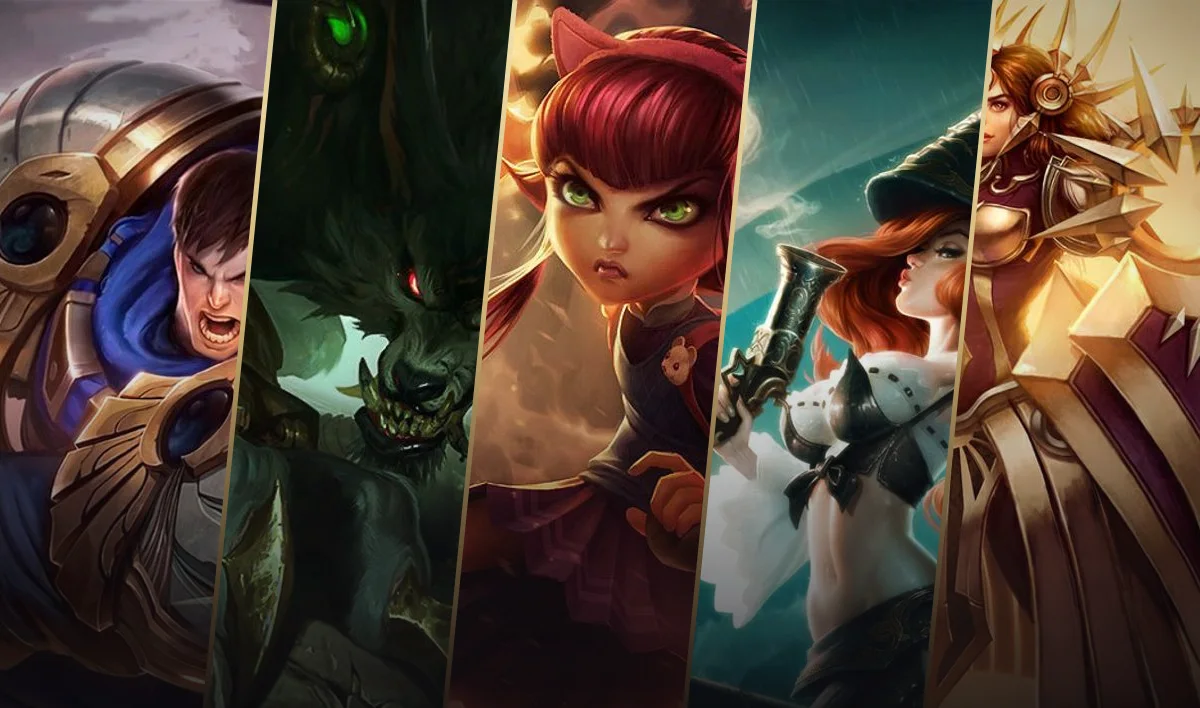
Best LoL Champions for Beginners: One Easy Pick per Role, the Runes, and Where to Start
Fifteen champions Riot itself rates as easy, three for every role, what each one asks of you, and how runes and summoner spells work, explained for your first games. Plus the mode that makes learning faster: Swiftplay.
The Short Answer: Your First Five Champions

Start with Garen (top), Warwick (jungle), Annie (mid), Miss Fortune (bot) or Leona (support), and play them in Swiftplay, where games last about 20 minutes. All five are rated Low difficulty by Riot, and each has one clear job. For runes, use the recommended page for your champion and role instead of building one yourself: Hexgate puts it into your lobby slot in one click.
Pick Your Role: Three Easy Champions Each
Every champion in League has a difficulty rating from Riot: Low, Moderate or High, shown on the champion's page in the client. The champions in this guide are all rated Low. Pick a role to see its three, the one ability each of them is built around, and the summoner spells the role takes.
 Top Lane
Top is a long one-on-one lane far from your team. Your job is to win or survive your duel, take your share of minion gold, and show up for big fights later.
Summoner spells Flash
 Teleportor
 Ignite
-
 Start here
Garen
Difficulty: Low PPerseverance
The classic first champion. Garen has no mana, so you never run out of resources, and his passive regenerates his health when he has not taken damage for a few seconds. Step back for a moment after a bad trade and you are healthy again. His abilities are a silence, a spin and an execute: run at someone, spin, finish them.
-

Malphite
Difficulty: Low RUnstoppable Force
A rock tank with one big moment. His passive shield blocks poke while you learn the lane, and his ultimate, Unstoppable Force, charges into the enemy team and knocks up every enemy it hits. Learn to land that one ability well and you are useful in every fight.
-

Nasus
Difficulty: Low QSiphoning Strike
Every time Nasus kills a minion or champion with his Q, the ability gets permanently stronger. That turns last-hitting, the most important habit in the game, into something you can see grow. Nasus is weaker early and very strong late, which teaches patience.
 Jungle
The jungler kills the monster camps between the lanes and helps lanes win with surprise attacks, called ganks. You must take Smite as a summoner spell to jungle.
Summoner spellsFlash Smite
-
 Start here
Warwick
Difficulty: Low WBlood Hunt
Warwick heals with his attacks, so clearing camps is forgiving, and his passive hunting sense shows him enemies on low health and speeds him toward them. The game points you at the ganks you should take.
-

Amumu
Difficulty: Low RCurse of the Sad Mummy
Amumu's ultimate, Curse of the Sad Mummy, locks down every enemy around him. Bandage Toss pulls him to a target, then the ultimate starts the fight. One combo, every teamfight.
-

Vi
Difficulty: Low RCease and Desist
Vi's ultimate, Cease and Desist, locks onto one enemy and cannot be stopped on the way. Pick a target, press the button, and your gank lands.
 Mid Lane
Mid is the shortest lane, close to both sides of the map. Mages there deal a lot of damage from range and help the jungler and side lanes.
Summoner spellsFlashIgniteorTeleport
-
 Start here
Annie
Difficulty: Low PPyromania
Every fourth spell Annie casts stuns. The game shows the count of her passive, so you always know when the stun is ready: count to four, then drop her bear, Tibbers, on the enemy team.
-

Lux
Difficulty: Low RFinal Spark
Lux fights from far away: a long-range root, a zone that slows, and a laser ultimate that reaches across the screen. Playing at range keeps you safe while you learn spacing.
-

Malzahar
Difficulty: Low RNether Grasp
Malzahar's voidlings push the minion wave for him, and his ultimate holds one enemy in place, point and click. His passive also makes him hard to burst when he has not been hit recently.
 Bot Lane
Bot is the marksman's lane, shared with your support. Your job is to last-hit, stay alive and deal steady damage from range in fights.
Summoner spellsFlash Healor
 Barrier
-
 Start here
Miss Fortune
Difficulty: Low RBullet Time
A straightforward lane and one of the strongest teamfight ultimates for a beginner: Bullet Time sprays a cone of bullets that can hit the whole enemy team from a safe distance.
-

Ashe
Difficulty: Low REnchanted Crystal Arrow
Every attack Ashe lands slows, so enemies struggle to run from you. Her ultimate is a giant arrow that flies across the whole map and stuns the first champion it hits.
-

Caitlyn
Difficulty: Low WYordle Snap Trap
Caitlyn has one of the longest attack ranges in the game, so she can farm and poke from distance, and her traps protect her when enemies get close.
 Support
The support helps the bot lane: protecting the marksman, starting fights and placing wards to show the map. You do not need minion gold; your support item rewards you for helping.
Summoner spellsFlashIgniteor Exhaust
-
 Start here
Leona
Difficulty: Low EZenith Blade
A tank who dashes in and stuns. Leona's job is to start the fight; your marksman finishes it. The clearest support role there is.
-

Soraka
Difficulty: Low RWish
Soraka heals allies by spending her own health, and her ultimate, Wish, heals your whole team wherever they are on the map.
-

Sona
Difficulty: Low RCrescendo
Sona's songs heal and speed up nearby allies, and her ultimate, Crescendo, stuns every enemy in a line. Stay behind your marksman and keep your songs going.
What Makes a Champion Good for Beginners
In practice, an easy champion has three things in common:
- A simple job. Start fights, survive the lane, or stand back and deal damage. Not all three at once.
- Forgiving mistakes. Healing, shields or a lot of health, so a bad trade does not end your lane.
- Abilities that are hard to miss. Point-and-click spells or big areas, so you can watch the map instead of your aim.
Easy does not mean weak. Several of these champions show up in high-level games too, because the same simple job wins fights at every rank.
Runes, Explained in One Minute
Before every game you choose a rune page. It looks complicated, but every page has the same shape:

A keystone. The big rune at the top, with the strongest effect. It shapes how your champion fights.


Three runes from the same tree as the keystone.


Two runes from a second tree.


Three stat shards: small bonuses like adaptive force, attack speed or health.
You do not need to understand every rune to start. The page most players use for your champion in your role is a safe default, and copying it by hand is where beginners usually go wrong: a wrong tree, a missing shard, or the previous champion's page left on by accident.
Summoner spells are simpler: almost everyone takes Flash, and the second spell depends on the role. Junglers must take Smite. Top laners often take Teleport or Ignite, mid laners Ignite or Teleport, marksmen Heal or Barrier, and supports Ignite or Exhaust.
Start in Swiftplay
Swiftplay is a normal (unranked) Summoner's Rift mode built for shorter games, and it is the best place to learn a role. You start at level 3 with 1,400 gold, the team that falls behind gets extra gold and experience to catch up, and Sudden Death at 25 minutes makes structures easier to destroy.
Across 1,513 Swiftplay games tracked by Hexgate in the last 60 days, the average game lasted 19.9 minutes, against 28.5 for Normal Draft. More games per evening means more practice per evening.
The one catch: before you queue, Swiftplay asks you for two champions for two different roles, with runes and summoner spells for each. Pick two easy champions from the lists above, one per role. The Swiftplay guide covers the rest of the rules.
Let Hexgate Set Up Your Picks, Then Help You Learn
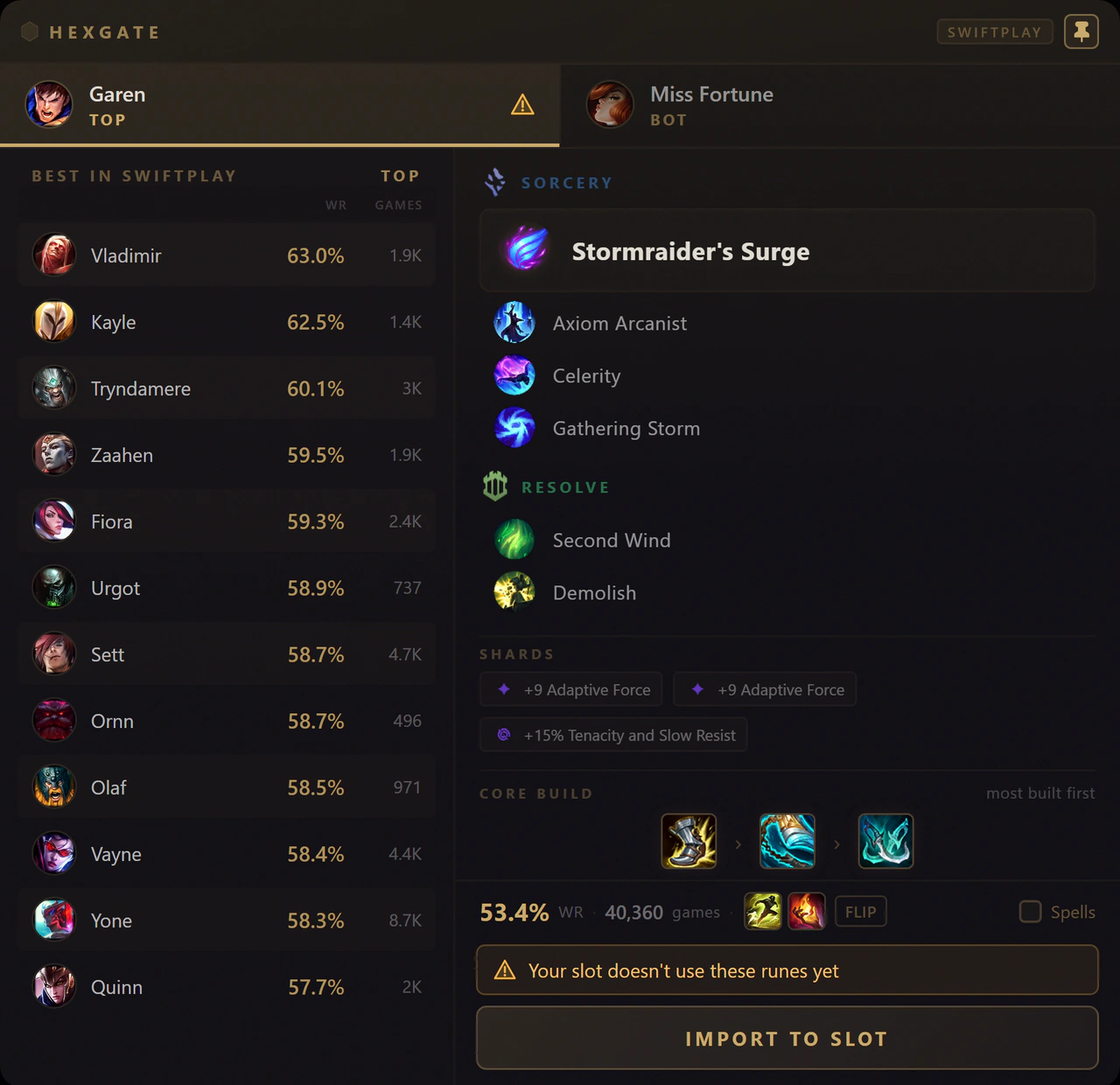
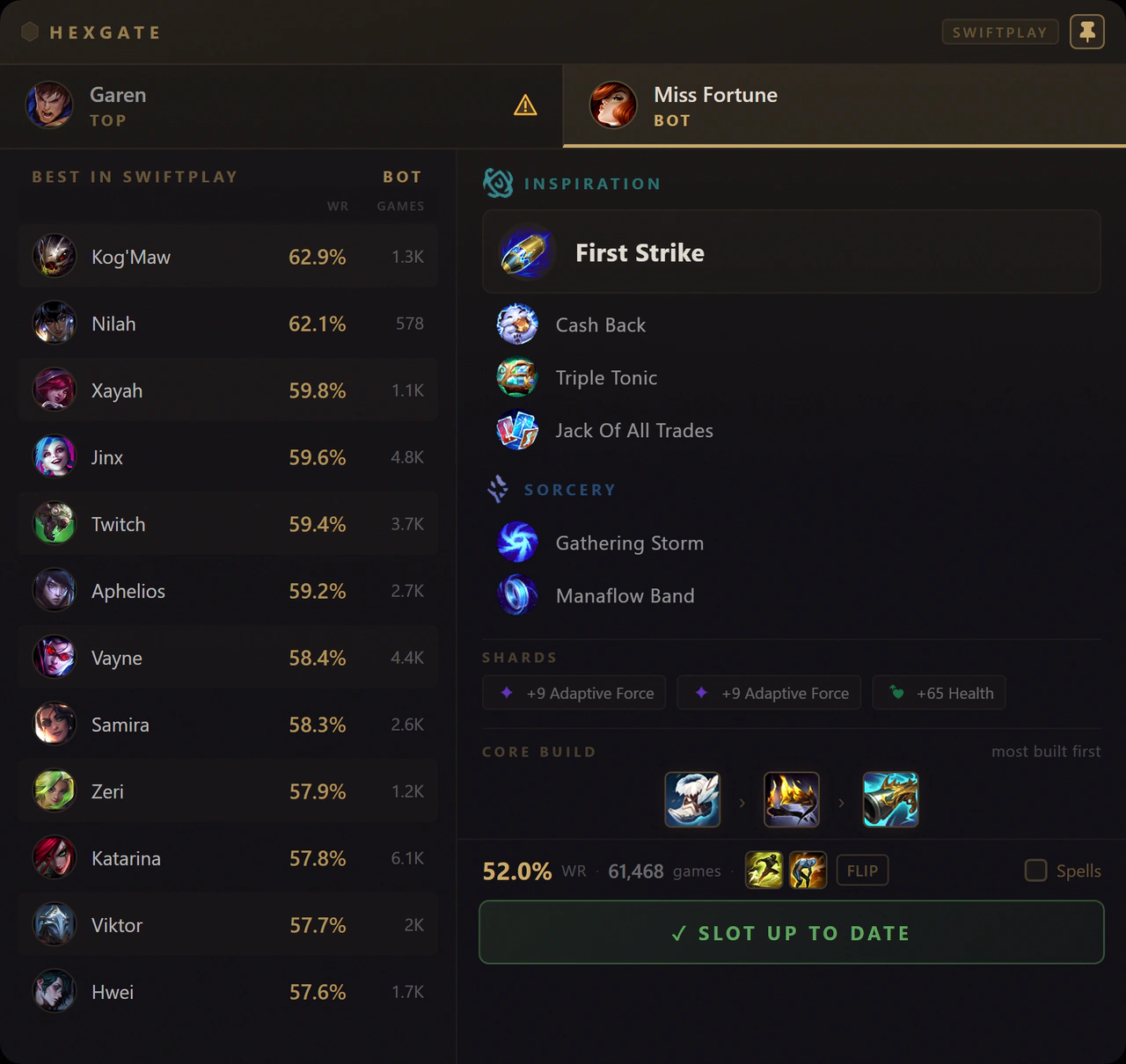
Hexgate is a free desktop app for League of Legends that helps at every step of a game: the lobby, champion select, the game itself and, when you want to learn faster, what happens after it. It starts in the lobby. When you sit in a Swiftplay lobby, it opens a window with one tab for each of your two picks:
- The best Swiftplay picks for that role. Click one and it goes into your slot.
- The recommended runes, summoner spells and core items for your champion in that role.
- Import to slot, which writes the runes (and the spells, if you tick Spells) into that pick in the League client.
- A warning when a slot still has a rune page that does not match, for example after you swapped champions.
The rest of every game
Champion select Free
In normal Draft and ranked games, the same runes and spells import in champion select, in one click, with counters and ban targets for your pick. ProLane matchup scoring adds runes and a build against your lane opponent.
In game Free
Press Tab and the Hexgate overlay shows the next item to buy, ranked against the five enemies you are actually facing, with the reason for every move. That takes care of the other question every new player has: what to build. The same Tab also puts each lane's item gold difference on League's own scoreboard, so you can see who is ahead without counting items. How counter-building works
When you want to learn faster
After the game Pro+
Match Breakdown of every ranked, Draft and Swiftplay game: why you won or lost, what hurt and what helped with the evidence from the game's own timeline, and one tip for your next game. Swiftplay games are judged at Swiftplay pace, not ranked pace. See a breakdown
Rewatch your deaths Pro+
Clips records every death, kill and assist while you play, ready to rewatch in slow motion when the game ends. The clips stay on your PC and are never uploaded. How Clips work
Once you play ranked Pro+
Lane Scouting on the loading screen: where the enemy jungler starts, which lane he ganks and how your lane opponent plays early, counted from their own ranked games. How Lane Scouting works
Frequently Asked Questions
What is the easiest champion in League of Legends?
Riot rates many champions Low difficulty. For a first champion, Garen (top), Annie (mid) and Miss Fortune (bot) are the most common recommendations: each has a short list of simple abilities and a clear job.
Which role is easiest for beginners?
Support with a tank like Leona, or bot lane with Miss Fortune, because you learn next to a teammate. Jungle is the hardest to start with: it asks you to track the whole map.
Should beginners play Swiftplay or Normal Draft?
Swiftplay. Games are about 8 minutes shorter, you start at level 3, and the catch-up rules keep a bad start from deciding the game. Normal Draft is the step after, once you know two or three champions.
Do I need to understand runes to start?
No. Use the recommended page for your champion and role. Learn what your keystone does first, then the rest over time.
What does Hexgate do for a new player?
For free: the best picks, runes and summoner spells for your Swiftplay slots in one click, the same runes in champion select with counters and ban targets, and in game the next item to buy against the enemy team. Pro+ adds a Match Breakdown of every game with a tip for the next one, Clips of every death to rewatch, and Lane Scouting once you play ranked.
Is Hexgate allowed by Riot?
Yes. Hexgate uses the League client's own interface to fill your pick slots and reads public game data. It does not modify game files, read game memory or automate gameplay.